
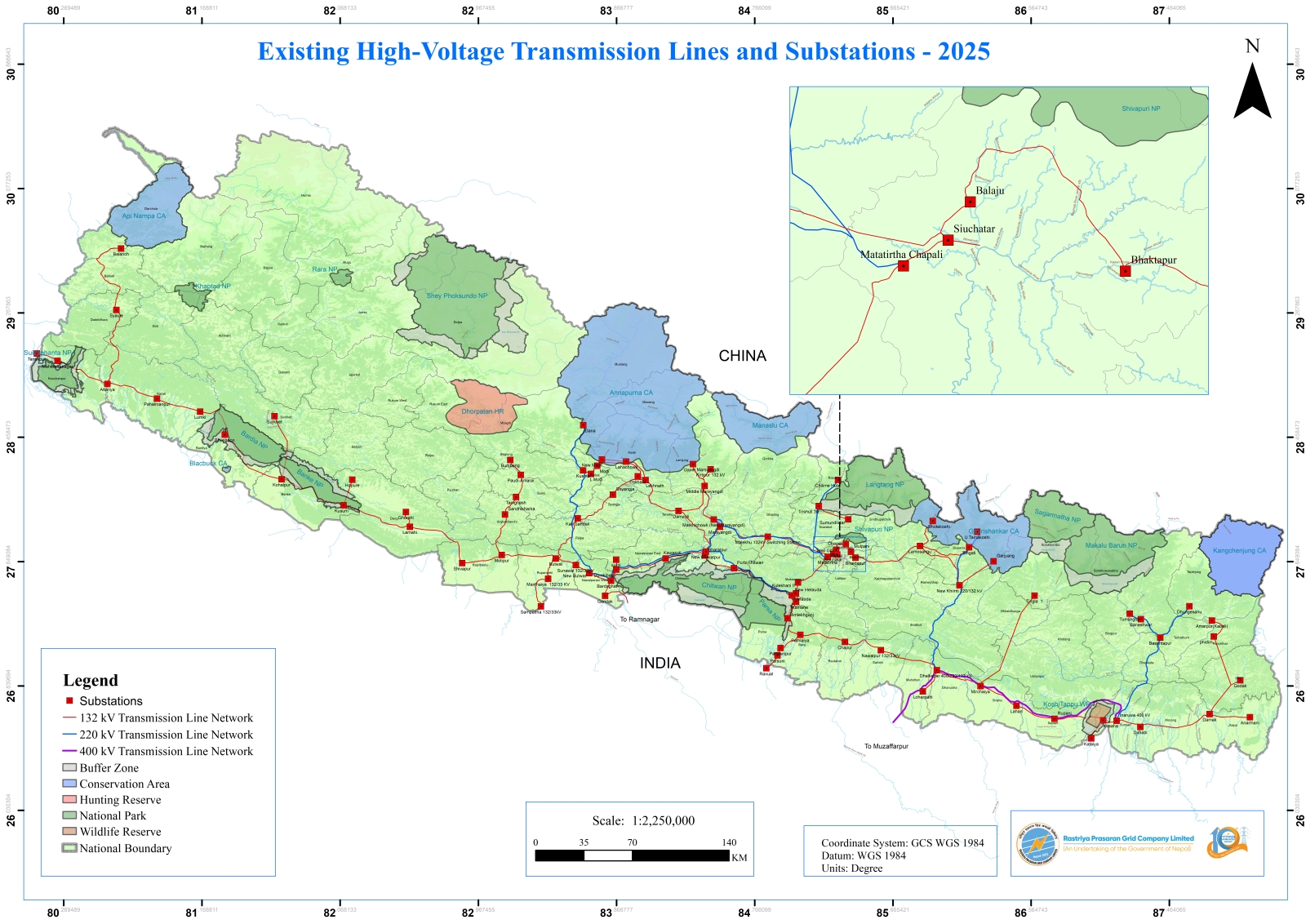
Nepal’s Existing Transmission Network
 View Full Info
(opens in a new tab)
Nepal’s transmission network is the backbone of the country’s electricity system, connecting generation centres with major load centres and enabling reliable power transfer across regions. The network is evolving from predominantly regional 132 kV systems toward a stronger and more interconnected grid, with 220 kV and 400 kV infrastructure forming the foundation of Nepal’s future electricity highway.
The existing system comprises high-voltage transmission lines, substations and associated grid infrastructure that support hydropower evacuation, domestic electricity supply and cross-border power exchange. With rapidly expanding generation and rising electricity demand, the network is being progressively strengthened through new transmission corridors, increased transformation capacity and strategic grid reinforcements.
While the Nepal Electricity Authority operates the existing transmission system, Rastriya Prasaran Grid Company Limited (RPGCL) is developing strategic transmission infrastructure to strengthen and expand Nepal’s national grid.
Future Transmission Network
Nepal’s future transmission network is being planned through a long-term, system-wide approach to accommodate rapidly growing electricity generation, rising domestic demand and expanding opportunities for cross-border power trade. The Transmission System Master Plan (TSMP) provides the strategic framework for identifying, analysing, prioritising and phasing the transmission infrastructure required to develop a reliable, resilient and integrated national grid.
The future grid is centred on a progressively stronger 400 kV national transmission backbone, complemented by 220 kV and 132 kV regional networks. This expansion will facilitate large-scale power evacuation from generation-rich regions, strengthen inter-regional power transfer, improve system reliability and provide adequate capacity for Nepal’s evolving electricity system.
RPGCL’s current Master Plan highlights a planned transmission network of approximately 6,867 km, comprising 2,515 km of 132 kV, 1,160 km of 220 kV and 3,192 km of 400 kV transmission lines. The plan also identifies 27 400/132 kV substations, 12 400/220/132 kV substations, 19 220/132 kV substations and 44 132 kV switching substations, with a combined planned transformer capacity of approximately 30 GVA.
The planning framework is designed around a future electricity system capable of accommodating approximately 38 GW of generation and 18 GW of domestic load, while supporting up to 16 GW of export power and maintaining 3 GW of spinning reserve. The planned transmission system is analysed against reliability criteria including N-1 and N-2 contingencies, with a targeted transmission-loss level of approximately 4%.
The future network also provides for greater regional connectivity, with the Master Plan identifying six 400 kV Nepal–India interconnections and two 400 kV Nepal–China interconnections, subject to system requirements, technical feasibility and future cross-border arrangements.
The transmission system will be developed progressively as generation, demand, power flows and cross-border exchange requirements evolve. Accordingly, the TSMP is a living planning framework, requiring periodic review and updating to ensure that transmission investments remain technically appropriate, economically justified and aligned with Nepal’s changing power system.
RPGCL is translating this long-term planning vision into strategic transmission projects across major generation corridors, including the Karnali, Bheri, West Seti, Mewa, Tamor, Arun and other strategic corridors. These projects are intended to build the high-capacity electricity highway required to connect Nepal’s generation potential with domestic load centres and future regional electricity markets.
6,867 km | 30 GVA | 38 GW |
|---|---|---|
Planned Transmission Network | Planned Transformer Rating | Future Generation Scenario |
18 GW | 16 GW | 3 GW |
|---|---|---|
Domestic Load | Export Power | Spinning Reserve |
⚡ Voltage-Wise Planning
🔌 132 kV — 2,515 km
Regional connectivity & generation evacuation
⚡ 220 kV — 1,160 km
High-capacity regional transmission corridors
🏗️ 400 kV — 3,192 km
National bulk-power transmission backbone
🛡️ Reliability & System Planning
🔄 N-1 / N-2
Contingency Planning
📉 ≈ 4%
Target Transmission Loss
🔗 112
Planning Buses
🌐 8
Potential 400 kV Cross-Border Corridors